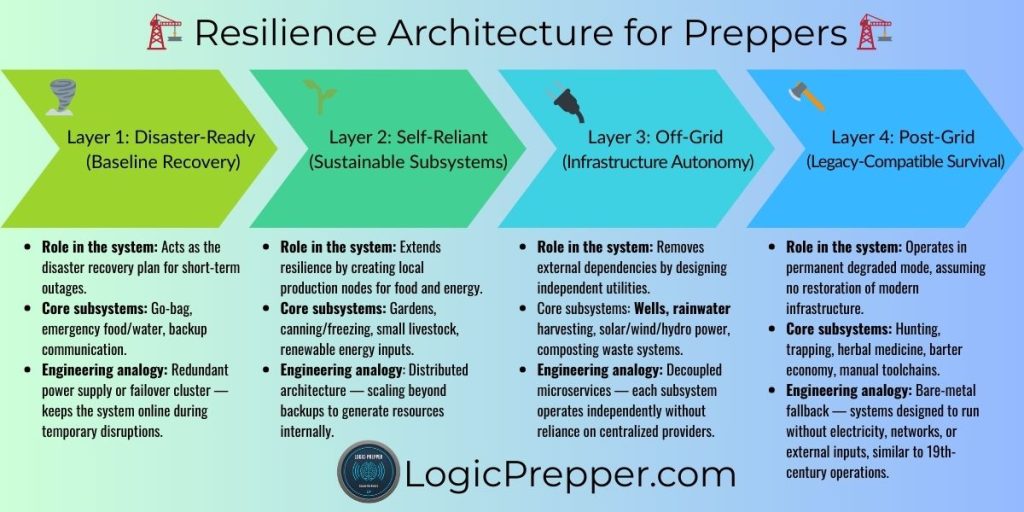
Systems View: Disaster-ready prepping is about building a baseline architecture for resilience. Just as a system requires redundancy and failover mechanisms, individuals need a personal disaster recovery plan. The “go bag” is your portable backup system — containing critical resources like food, water, first aid, communication tools, and documentation.
From a systems engineering perspective, this level of preparedness is about short-term uptime. You’re not redesigning the grid; you’re ensuring continuity during outages. Think of it as a two-week buffer against external service failures.
Keywords to weave in: emergency preparedness checklist, go bag essentials, short-term survival kit, disaster recovery plan, grid-down event.
Core Components:
Redundancy: Multiple light sources, backup power banks.
Data Integrity: Copies of IDs, insurance, and medical records.
Failover Resources: Two weeks of food and water per person.
This category appeals to beginners searching for practical, actionable steps to survive hurricanes, blizzards, or earthquakes without over-engineering their lifestyle.
Systems View: Self-reliance is about scaling the architecture beyond temporary outages. Instead of relying on external supply chains, you design subsystems for food, energy, and resource management. Gardening, canning, freeze-drying, and raising small livestock are essentially local production nodes in your personal ecosystem.
From an engineering lens, this is about sustainable throughput. You’re not just surviving; you’re provisioning resources with predictable output.
This category resonates with those searching for “how to start homesteading” or “prepper gardening tips,” offering a blueprint for long-term independence.
Systems View: Off-grid prepping is about infrastructure autonomy. Instead of consuming shared utilities, you design independent subsystems for water, power, and waste. Wells, rainwater harvesting, solar arrays, and composting toilets are essentially private service providers in your architecture.
From a systems engineer’s perspective, this is about removing external dependencies. You’re not necessarily self-sustaining, but you’re decoupled from centralized services.
Keywords to weave in: off-grid living, solar power systems, rainwater harvesting, independent utilities, grid-free lifestyle.
Core Components:
Water Systems: Wells, filtration, rainwater collection.
Energy Systems: Solar, wind, hydro.
Waste Systems: Composting, septic, recycling.
This appeals to searchers typing “how to live off-grid” or “off-grid solar power,” offering practical guides for autonomy.
Systems View: Post-grid prepping is about designing for permanent collapse. Survivalists anticipate a zero‑after event where modern infrastructure never returns. This requires building legacy-compatible systems — skills and tools that function without electricity, supply chains, or centralized governance.
From an engineering lens, this is about operating in degraded mode indefinitely. You’re architecting for resilience in a world that resembles the 1850s.
Keywords to weave in: survivalist skills, societal collapse, long-term grid down survival, back-to-basics living.
This category attracts those searching “how to survive societal collapse” or “prepper collapse scenarios,” offering a roadmap for thriving in a post-grid world.
🏗️ Resilience Architecture for Preppers
Layer 1: Disaster-Ready (Baseline Recovery)
Role in the system: Acts as the disaster recovery plan for short-term outages.
Engineering analogy: Bare-metal fallback — systems designed to run without electricity, networks, or external inputs, similar to 19th-century operations.
Owen is a systems engineer and the founder of LogicPrepper.com, a technical resource dedicated to infrastructure reliability and off-grid design. With a professional background including writing A-level specifications for the Aegis Weapons System, he specializes in translating complex engineering principles into actionable DIY blueprints for the preparedness community. When he isn’t stress-testing solar arrays or auditing water filtration topologies, he’s usually in his “Logic Lab” building redundant 3D-printed hardware solutions.