Download FREE E-book

High Level Overview
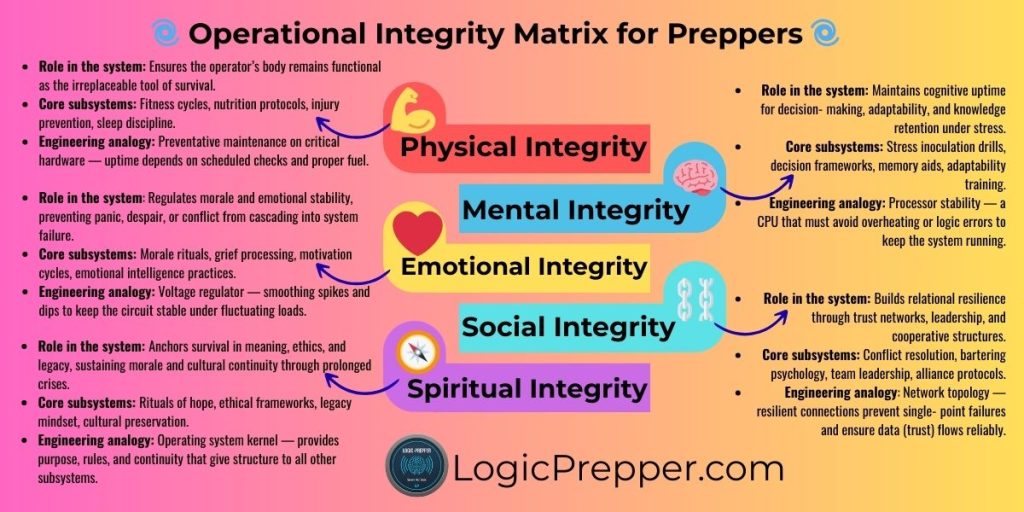
The Operational Integrity Matrix defines the five pillars of human resilience—physical, mental, emotional, social, and spiritual integrity—as the irreplaceable foundation of survival. While the 11 systems of resilience engineer power, communications, logistics, and shelter, and the 4 prepper types map strategic approaches to disruption, every system depends on the uptime of the operator. This matrix applies preventative maintenance logic to the human body and mind, ensuring that fitness, cognition, morale, community, and meaning remain fully operational. By integrating human integrity into the broader resilience architecture, the Matrix completes the survival equation: gear and systems are replaceable, but the operator is not.
“The Operational Integrity Matrix is inspired by military decision‑making doctrine, specifically Colonel John Boyd’s OODA Loop (Observe, Orient, Decide, Act), which emphasizes continuous adaptation and operator uptime under stress.”
Our operational integrity matrix in a nutshell:
💪 Physical Integrity:
Preventative maintenance of the body as the irreplaceable survival tool.
🧠 Mental Integrity:
Cognitive uptime for decision‑making, adaptability, and knowledge retention under stress.
❤️ Emotional Integrity:
Regulation of morale and fear to sustain motivation and group cohesion.
⛓️ Social Integrity:
Trust networks, leadership, and bartering psychology that extend resilience beyond the individual.
🧭 Spiritual/Existential Integrity:
Meaning anchors and ethical frameworks that preserve hope and cultural continuity.
Details of Each Category in the Operational Integrity Matrix
💪 Physical Integrity
Systems View: Physical integrity is about treating the body as the most critical subsystem in survival. Just as machines require preventative maintenance, the operator must maintain fitness, nutrition, and injury prevention to ensure uptime. The body is the only tool that cannot be replaced post‑grid.
From a systems engineering perspective: This level of preparedness is about biological uptime. You’re not just exercising for health — you’re ensuring the operator can haul water, chop wood, and sustain labor cycles without collapse. Think of it as scheduled maintenance for the human machine.
Core Components:
- Preventative Maintenance: Daily exercise cycles, stretching, and conditioning.
- Fuel Management: Balanced nutrition and hydration protocols.
- Downtime Scheduling: Sleep discipline and recovery cycles.
- Fault Prevention: Hygiene, injury avoidance, and immune system support.
Appeal: This category resonates with preppers who understand that gear is useless if the operator cannot physically deploy it.
🧠 Mental Integrity
Systems View: Mental integrity is about cognitive uptime — the ability to process information, make decisions, and adapt under stress. Just as processors must avoid overheating or logic errors, the operator’s mind must remain stable under fatigue and uncertainty.
From a systems engineering perspective: This is about maintaining decision‑making capacity during overload conditions. You’re not redesigning the brain; you’re ensuring it doesn’t crash when inputs spike. Think of it as processor stability in a high‑stress environment.Core Components:
- Stress Inoculation: Scenario training under pressure.
- Decision Frameworks: OODA (Observe, Orient, Decide, Act) loops, risk matrices, prioritization logic.
- Knowledge Retention: Memory aids, skill refresh cycles.
- Adaptability: Cross‑training and mental flexibility drills.
Appeal: This category appeals to those who want to sharpen their survival mindset and avoid cognitive collapse during crises.
❤️ Emotional Integrity
Systems View: Emotional integrity is about regulating morale and inner stability. Just as voltage regulators smooth spikes and dips in a circuit, emotional resilience prevents panic, despair, or anger from cascading into system failure.
From a systems engineering perspective: This is about stabilizing the operator’s emotional current. You’re not eliminating stress — you’re ensuring it doesn’t destabilize the system. Think of it as a voltage regulator for human morale.
Core Components:
- Morale Protocols: Rituals, routines, and motivational anchors.
- Grief Processing: Frameworks for loss and trauma.
- Motivation Cycles: Sustaining drive in prolonged isolation.
- Emotional Intelligence: Empathy and regulation in group settings.
Appeal: This category resonates with preppers who know survival isn’t just about strength — it’s about sustaining hope and cohesion.
⛓️ Social Integrity
Systems View: Social integrity is about relational resilience — building trust networks, leadership structures, and cooperative systems. Just as network topologies prevent single‑point failures, social cohesion ensures survival extends beyond the individual.
From a systems engineering perspective: This is about designing resilient human networks. You’re not just making friends; you’re engineering alliances that prevent collapse. Think of it as network redundancy for human relationships.
Core Components:
- Trust Protocols: Building and maintaining reliable alliances.
- Conflict Resolution: Frameworks for disputes under stress.
- Leadership Models: Role clarity and accountability in small teams.
- Bartering Psychology: Fairness and predictability in exchange systems.
Appeal: This category appeals to preppers who understand that no one survives alone — community is the ultimate force multiplier.
🧭 Spiritual / Existential Integrity
Systems View: Spiritual integrity is about anchoring survival in meaning, ethics, and continuity. Just as an operating system kernel provides rules and structure, existential resilience provides purpose beyond scarcity.
From a systems engineering perspective: This is about ensuring the operator’s “why” remains intact. You’re not redesigning belief systems; you’re ensuring they provide continuity under collapse. Think of it as the kernel that keeps the system coherent.
Core Components:
- Meaning Anchors: Purpose beyond survival.
- Ethical Frameworks: Fair resource distribution and governance.
- Legacy Mindset: Preserving culture, stories, and traditions.
- Rituals of Hope: Practices that sustain morale in prolonged crises.
Appeal: This category resonates with preppers who see survival not just as endurance, but as preserving identity, ethics, and legacy.
🌀 The Operational Integrity Matrix 🌀
1. Physical Integrity
- Role in the System: Acts as the primary power plant and mechanical chassis for all labor-intensive tasks.
- Core Subsystems: Metabolic efficiency, functional strength, sleep architecture, and metabolic thermal regulation.
- Engineering Analogy: The Primary Engine & Battery Bank — The hardware that determines the maximum work-output and “up-time” of the entire operation.
2. Mental Integrity
- Role in the System: Serves as the Central Processing Unit (CPU) and firmware for real-time problem solving.
- Core Subsystems: OODA Loop speed, technical skill retention, stress-inoculation, and situational awareness.
- Engineering Analogy: The Logic Controller (PLC) — The onboard processor that interprets sensor data and executes system overrides during a crisis.
3. Emotional Integrity
- Role in the System: Functions as internal buffer management to prevent “system shock” and psychological fatigue.
- Core Subsystems: Morale maintenance, fear/grief regulation, motivation, and psychological “brown-out” prevention.
- Engineering Analogy: The Surge Protector & Internal Dampener — Absorbs the “spikes” of high-stress events to prevent internal components from redlining and burning out.
4. Social Integrity
- Role in the System: Defines the network protocols for multi-node communication and resource sharing.
- Core Subsystems: Leadership algorithms, tribal cohesion, negotiation logic, and conflict resolution.
- Engineering Analogy: The Network Interface & Signal Protocol — Ensures multiple “Operator Nodes” can sync data and labor without signal noise or packet loss.
5. Spiritual/Existential Integrity
- Role in the System: Represents the “Command Intent” and “Source Code” that drives the mission forward.
- Core Subsystems: Purpose-driven survival, legacy mindset, ethical anchoring, and grit.
- Engineering Analogy: The BIOS / Root Kernel — The fundamental instruction set that dictates the system’s “Will to Run,” even when all other systems are in a degraded state.
Summary: The Operational Integrity Matrix
The Operational Integrity Matrix defines the five pillars of human resilience—💪 Physical, 🧠 Mental, ❤️ Emotional, ⛓️ Social, and 🧭 Spiritual integrity—as the irreplaceable foundation of survival. While the 11 resilience categories engineer systems and the 4 prepper types map strategic approaches, the Matrix ensures the operator remains functional under stress. By treating human uptime as preventative maintenance, it integrates seamlessly into Systems Philosophy, aligning with principles of redundancy, failover, and continuous adaptation.
This framework reminds preppers that gear and infrastructure can be replaced, but the operator cannot. The Matrix completes the survival equation: resilient systems, strategic archetypes, and human integrity woven into one unified architecture.